
Whoa! The first time I pulled up a messy Solana transaction and watched it unfold on Solscan, I felt oddly relieved. It showed me each instruction, each token movement, and the little gas-like lamports that drifted away. Seriously? Yeah. Block explorers can be boring, but Solscan made a confusing moment readable. My instinct said: this is the kind of tool you want in your back pocket when things go sideways.
Okay, so check this out—Solscan isn’t just a pretty list of transactions. It surfaces patterns. It lets you trace which program called another, and it highlights token mints and holders without burying you in noise. At first I thought it was all surface-level polish, but then I started digging into program logs and event traces. Actually, wait—let me rephrase that: once you dig past the default panes, there’s a lot more meat. On one hand it looks simple; on the other hand, it supports advanced use-cases for devs, traders, and auditors alike.
Here’s what bugs me about most explorers: they either treat users like coders or like complete novices. Solscan walks that line better than most. It’s fast. The search bar responds immediately. Charts render without lag. The interface gives you quick things—like token transfers—and deeper things—like parsed instructions and inner instructions—when you want them. I’m biased, but that balance matters when you’re tracking a large transfer or trying to debug a program interaction.
Let me be blunt: nothing is perfect. There are times when data snapshots and real-time states slightly diverge. Solana’s finalization model is nuanced, and depending on RPC nodes you query, confirmations may show micro differences. My rule of thumb became: check both confirmed and finalized states, and cross-reference if something looks off. Hmm… that extra step saved me more than once.
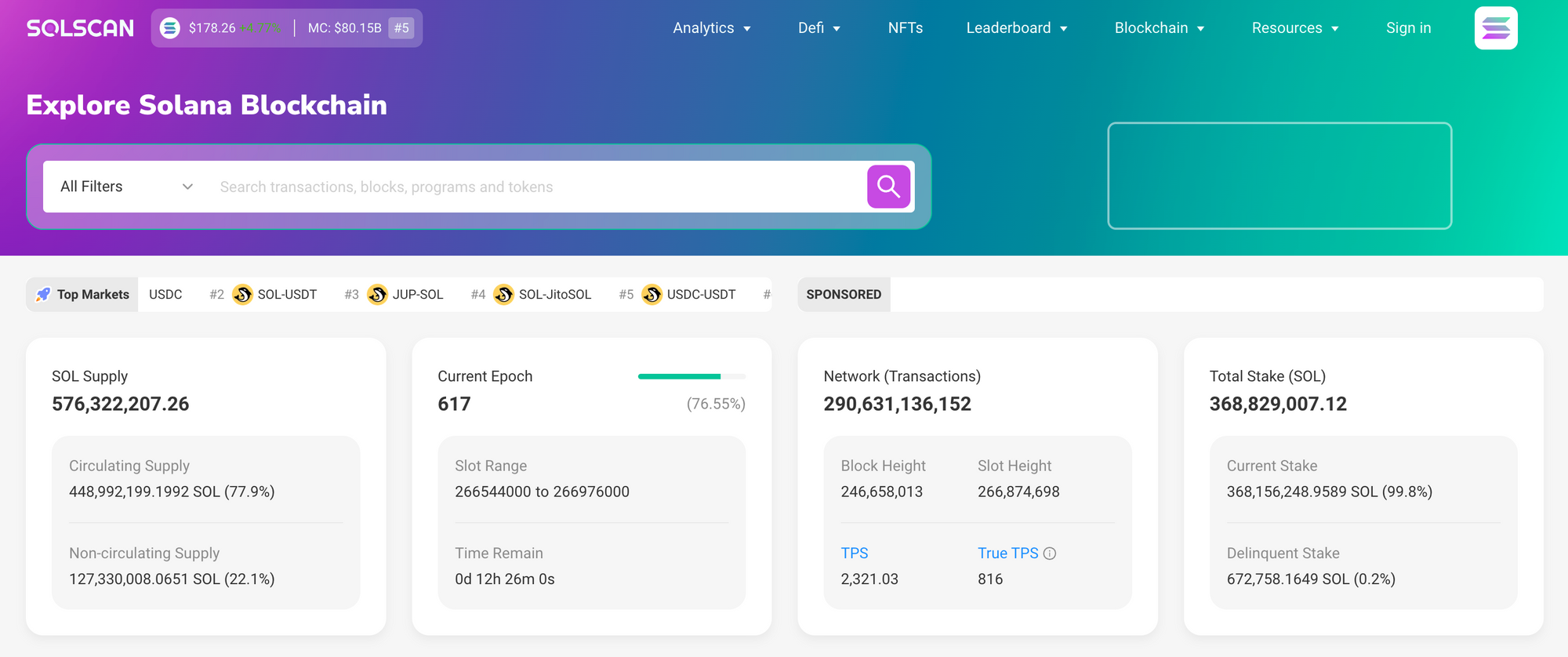
What I Use Solscan For — Practical, Not Theoretical
I use Solscan in three big ways. First, quick checks: Is my transaction stuck? Where did my NFT or token go? Second, analysis: Who holds the most of a mint? How many transfers did a wallet make, and when? Third, verification: Did that swap actually call a known AMM program? Each of those tasks asks for different things.
For quick checks, Solscan’s address and transaction pages are very efficient. They give you a timeline, show the status, and let you inspect individual instructions. You can copy logs and share them. For trades and DeFi, there’s a transaction-level breakdown that shows which program executed which instruction, and the raw changes to accounts. That clarity can tell you if a trade failed because the price slippage was too high, or because a rent-exempt requirement wasn’t met.
For deeper analysis, I lean on its analytics dash. There are charts for token supply changes, large transfers, and block production. The UI surfaces top holders and top transactions for a mint, which is great when you’re vetting a token. And for NFTs, the collection page gives a snapshot of trait distributions and trading volume—useful when you’re trying to gauge demand.
Something felt off about a recent addr I traced, and Solscan let me see the nested instruction that caused the issue. It showed the sequence clearly, and that saved me hours. Small wins like that build trust.
Developer Tools and Program Transparency
Developers need more than pretty graphs. They need instruction parsing, program logs, and message decoding. Solscan gives parsed instruction views for major programs—Serum, Raydium, Metaplex, and many SPL programs. You can see inner instructions. You can also inspect the program execution order and runtime accounts. For audits, that’s golden.
There’s an API too. You can pull transaction lists, token holders, and block stats. I used the API to build a small internal dashboard that tracked mint concentrations across several tokens. It was straightforward enough: hit the endpoint, cache responsibly, and visualize. The docs aren’t perfect though. They assume a bit of familiarity. So if you’re new, allocate time for trial and error. Somethin’ like that.
On the other hand, be cautious about depending solely on a third-party explorer for automated decisions. The explorer mirrors network data, and when you need deterministic verification you might want to query multiple RPCs or the chain directly. That’s just good engineering hygiene.
Speed, Reliability, and When It Trips Up
Speed is one of Solana’s selling points and Solscan leverages that. Search is snappy. Pages load quickly. But remember that explorers rely on indexers and back-end infrastructure. During cluster congestion or RPC node hiccups, the explorer can show partial or delayed results. I’ve seen mempool-ish windows where transactions appear then disappear briefly. That freaked me out the first time. Seriously? Yup.
So here’s a practical checklist I follow when something looks weird:
- Confirm the transaction signature on another explorer or via a reliable RPC call.
- Check the block height and see if it’s confirmed or finalized.
- Look at program logs to see if an instruction failed or reverted.
- Double-check token balances after a couple of confirmations.
These steps take a few minutes. They help avoid false alarms or panic trades. Traders will appreciate that kind of caution, because speed without verification is risky.
Usability Tricks I Wish More People Knew
Pro tip: use the “inner instructions” and “logs” panels. Many users stop at the top-level instruction and miss the nested calls that matter. Also, use the token holder page to spot concentration risks—if 90% of supply sits with a few wallets, that’s a red flag. Another trick: the block explorer’s CSV export helps when you want to run analysis offline or batch process transaction histories.
I’ll be honest—some labels and UI affordances could be clearer. But the functionality is there. You just have to poke around. (oh, and by the way…) If you work with NFT collections, check the “creators” and “mint activity” views; they sometimes reveal lazy mints or consolidation activity that price charts don’t show.
How Solscan Compares — A Short, Honest Take
On wallets and explorers, choice matters. Solscan sits between lightweight explorers and full analytics platforms. It’s more accessible than raw RPC queries, but more powerful than a minimal block view. Alternatives exist, and they each bring strengths—some focus on protocol-level metrics, others on on-chain social signals. Use the right tool for the job. I’m not saying Solscan is always best; it just hits a sweet spot for many tasks.
My take: if you want a reliable, easy-to-navigate explorer with developer-friendly details, give Solscan a serious look. For a one-stop reference, it works well. And when you need deeper, program-specific telemetry, pair it with direct RPC checks or specialized analytics.
For an official reference or to jump in, here’s a trusted page for your next check: solscan explorer official site
FAQ — Quick Answers from My Day-to-Day
Q: Can Solscan decode all program instructions?
A: Not always. It decodes most common SPL and major DeFi program instructions, but obscure or custom programs might show raw data. In those cases, you should consult the program’s source or run your own message decoding.
Q: Is Solscan’s data authoritative?
A: Solscan reflects on-chain data as indexed by its back-end. It’s authoritative for many purposes, but for critical automation or legal evidence you should cross-verify with primary RPCs and the chain state, especially during edge-case conditions.
Q: How do I troubleshoot a failed transaction?
A: Look at the transaction logs and inner instructions first. Check for “insufficient funds”, “account not rent exempt”, or “instruction errors”. Then check the accounts’ post balances and program return data. If needed, reproduce the call in a sandbox or devnet environment.
So where does this leave us? Curious and cautious. I still rely on Solscan a lot. It helps me move faster and think clearer. But I also know when to slow down and verify, because the blockchain can be messy and human systems are imperfect. That tension keeps me humble—and keeps my watchlist tidy. Somethin’ to keep in mind next time you click a signature link: read the logs. They’re telling you something.